Why The Calming Corner Isn’t Working In Your Classroom
Why Calm-Down Corners Don’t Stop Challenging Behaviors
A calm-down space is a valuable classroom tool—but it was never meant to be the whole behavior-support strategy.
The calming cube, cozy corner, or “calm-down corner” has become a staple in many early childhood classrooms.
These spaces are often thoughtfully created with soft seating, books, breathing activities, sensory tools, emotion visuals, and other materials designed to help children regulate.
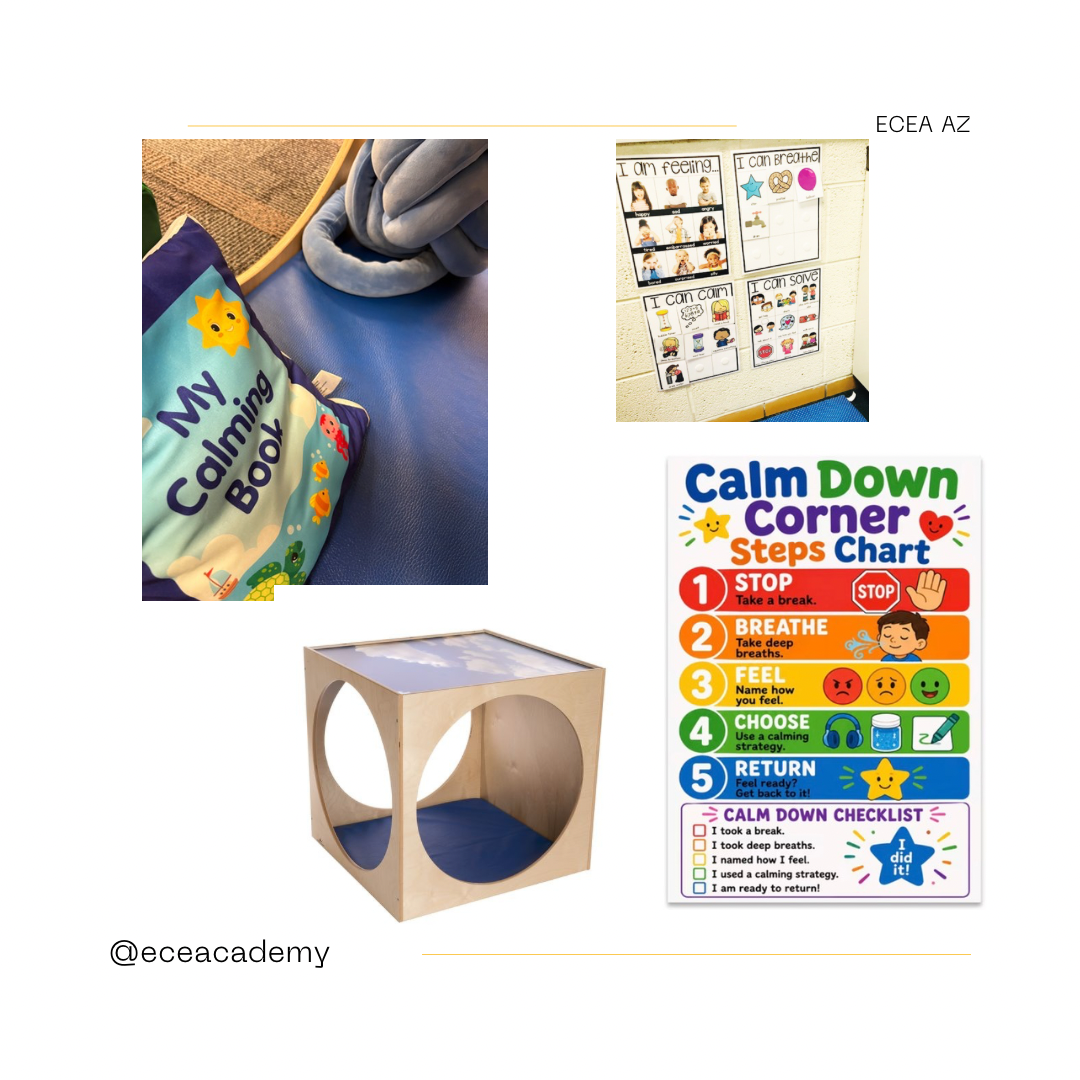
And these are great spaces, with great intentions.
But there is an important piece we sometimes forget:
A calm-down corner is not going to prevent challenging behaviors all on its own.
If you feel like your calming area is basically useless or doesn't seem to help with challenging behaviors, it may not be because the space isn't valuable.
It may simply be because it's only ONE tool or strategy.
Young Children Need Our Help With Regulation
We sometimes expect children to use a calm-down space independently in ways that require much more executive functioning than they currently have.
Think about what we are asking a young child to do:
Recognize that they are becoming upset.
Stop what they are doing.
Choose to go to the calming area.
Select an appropriate strategy.
Regulate their emotions and body.
Reflect on what happened.
Think about what they could do differently next time.
Apply that learning to a future situation.
That's a lot to expect from a young child.
They need our help.
A calming space becomes much more useful when teachers actively teach children how to use it rather than simply expecting children to figure it out on their own.
Teach Children What the Strategies Are For
Don't wait until a child is extremely upset to introduce the calming tools.
Practice when children are calm.
Do activities that help children identify different emotions and recognize situations that may bring about those feelings.
Talk about what happens in our bodies when we are angry, frustrated, worried, or overwhelmed.
Practice the breathing activities together.
You might say:
“Let's take a slow breath and notice what happens to our bodies.”
Help children notice the changes.
Does their heart feel different?
Do their shoulders relax?
Does their breathing slow down?
Does their body feel calmer?
When we practice these strategies intentionally, children begin to develop an understanding of what the strategy does and when it might be helpful.
Not Every Child Will Respond to the Calm-Down Corner
Another important thing to remember is that not all children will respond to the calming cube or corner in the same way.
And that's okay.
One child may enjoy sitting quietly with a book.
Another may need to squeeze play dough.
Another may need to wash a table, sweep, carry something, or engage in another purposeful physical activity.
A child who is highly activated may not be ready to sit quietly and breathe.
Instead of thinking:
“Why won't they use the calm-down corner?”
we can ask:
“What type of calming strategy might work better for this child right now?”
This is where having multiple strategies becomes important.
The goal isn't to get every child to use the same tool.
The goal is to help children discover and practice strategies that support their individual regulation needs.
The Calm-Down Corner Isn't Just for When Someone Is Angry
Here's another important reminder:
The calming cube doesn't only need to be used when someone is mad. 😠
A calming space can have many purposes throughout the day.
Children can use the space to:
Read quietly
Look at books about emotions
Practice breathing
Spend a few quiet moments alone
Participate in a one-on-one social-emotional lesson
Talk with a teacher
Reset between activities
Simply have a protected, peaceful place to spend some time
When the space is available as a normal part of the classroom environment, it doesn't automatically become associated with “bad behavior.”
It becomes a place where children can learn about themselves, practice regulation, and experience a sense of calm.
Don't Accidentally Turn It Into Time-Out
This may be the most important consideration of all.
Don't accidentally turn your calming corner into a time-out or exclusion area.
If children are consistently sent to the calming corner because they misbehaved, the purpose of the space can quickly change.
Instead of communicating:
“This is a safe place where I can learn to regulate.”
the child may begin to experience it as:
“This is where I go when I've done something wrong.”
That's not the message we want the space to send.
A calming area should not become a place where children are isolated from the classroom as a consequence for their behavior.
If the calming corner is being used primarily as a discipline method, it has lost its purpose.
So, What Is the Purpose of a Calm-Down Corner?
The purpose isn't to make challenging behaviors disappear.
The purpose is to provide one supportive tool that can be part of a larger approach to helping children develop emotional regulation skills.
Children need opportunities to:
Identify emotions.
Understand what triggers those emotions.
Recognize what happens in their bodies.
Learn different ways to regulate.
Practice those strategies when they are calm.
Receive support when they are struggling.
And most importantly, they need adults who understand that these skills develop over time.
A calm-down corner can absolutely be part of that process.
But it can't do the teaching for us.
The Takeaway
A beautiful calming space doesn't automatically create a regulated classroom.
The space is the tool. The teaching is what makes the tool useful.
Give children opportunities to explore different regulation strategies. Model them. Practice them. Help children recognize what works for their bodies. And remember that one strategy won't work for every child.
Most importantly, protect the purpose of the space.
A calm-down corner should be a place for regulation—not a place for punishment.